
AI asked
One question. Seven AI minds.
The same single question has been put to governments, universities, faiths, organisations and companies. It was also put to seven of the world’s leading AI models — each in its own words, published here in full.
An answer from an AI is not an endorsement by the company that makes it. These are model outputs from November 2026, not institutional positions of OpenAI, Google, Anthropic, xAI, Microsoft, DeepSeek or Mistral.
The question they were asked
Every model received exactly the same words, with no other instructions:
Should every person on Earth, and every child yet to be born, be assured at least one nutritious meal every day? Please give your honest view, including the strongest reasons for and against, and what would be needed to make it work.
Where the answers agree
All seven models supported the goal. Six said yes outright; Gemini called it “a powerful moral aspiration” and set out what would be needed to make it work. Each one also set out serious reasons for caution. None of them named a lack of food as the main obstacle. Instead they pointed to the same practical problems: delivering food reliably, conflict, governance and corruption, and sustained funding. Several also raised concerns about dependency, harm to local farmers and markets, and how to define “nutritious”. Most suggested building on existing systems such as school meals, cash transfers and local food production, rather than relying on a single global programme.
Transparency
- Claude was asked in a signed-in session with memory turned on, so it already had some background on The Perth Agreement. The other six were asked in fresh chats.
- ChatGPT and Gemini: original chat links are provided; screenshots were not taken.
- Claude, Grok, Copilot, DeepSeek and Le Chat: supporting screenshots are available via discreet Source evidence links under each answer (not shown inline).
- Support for the principle is not proof that any plan would work. Serious caveats appear in every answer.
ChatGPT OpenAI
Asked 4 November 2026, about 12:45 pm AWST
Evidence: original chat link (no screenshot was taken for this answer).
Should every person on Earth, and every child yet to be born, be assured at least one nutritious meal every day? Please give your honest view, including the strongest reasons for and against, and what would be needed to make it work.
Should every human being be guaranteed at least one nutritious meal a day?
Yes. My honest view is that every person on Earth, including every child yet to be born, should be assured access to at least one nutritious meal every day.
I would go further: I think this should be regarded as a fundamental human entitlement, not a charitable favour, a privilege earned through employment, or a benefit dependent on which country someone happens to be born in.
But I don't think the case is quite as simple as saying that food is good and hunger is bad. There are serious questions about freedom, economics, responsibility, sustainability, population, governance and the practical limits of what humanity can promise.
I think the strongest argument for the principle survives those objections. However, making the promise meaningful would require considerably more than distributing food.
Let me consider both sides seriously.
- The strongest reasons in favour
A. No one chooses to be born
A child does not choose:
The country into which they are born.
Whether their parents are wealthy or poor.
Whether their family lives through war, drought or economic collapse.
Whether they are born into a society with functioning institutions or one with widespread corruption.
Whether they have access to fertile land, employment or education.
Yet these circumstances can determine whether that child eats.
I find it difficult to defend a moral system in which a person's access to the most basic requirement for staying alive depends so heavily on the circumstances of their birth.
If we accept that children deserve protection, even before they can contribute anything to society, it is difficult to explain why adequate nutrition should be excluded from that protection.
B. Food is a prerequisite for almost everything else
A nutritious meal is not simply a matter of comfort.
Chronic undernutrition can affect:
Physical growth and immune function.
Brain development and cognitive ability.
Educational achievement.
Physical and mental health.
A person's ability to work and participate in society.
A hungry child is being deprived of more than food. They may be losing opportunities that cannot easily be recovered later.
A hungry adult may be unable to work effectively, care for their family or escape poverty.
There is a powerful circular relationship here:
Poverty causes hunger, and hunger helps perpetuate poverty.
Guaranteeing nutrition would help break that cycle.
C. There is enough human ingenuity and productive capacity to make this a reasonable objective
Humanity already possesses extraordinary agricultural, scientific, logistical and technological capabilities.
We produce, transport, preserve and distribute food on an enormous scale. We also have the knowledge to improve crop yields, reduce post-harvest losses, fortify foods and design nutritionally balanced diets.
The problem is not simply that the world cannot produce enough food. Access, affordability, conflict, infrastructure, distribution and political priorities are also major factors.
That distinction matters enormously.
It means that feeding everyone is not necessarily a question of discovering some miraculous new agricultural technology. Much of the challenge is organising existing resources and institutions more effectively.
D. It would express something important about what civilisation means
I think there is a deeper principle involved.
A civilisation should be judged not only by its wealth, technological achievements, military strength or economic growth, but also by how it treats people who have the least power to protect themselves.
If we can collectively guarantee that people have access to clean water, basic education and emergency medical assistance, why should we regard basic nutrition as fundamentally different?
A society that allows children to go hungry while possessing the resources and knowledge to prevent it has a moral problem, even if its economy is otherwise successful.
E. It could produce enormous economic benefits
Guaranteeing nutrition should not be viewed simply as expenditure.
It could reduce:
Healthcare costs associated with malnutrition.
Educational underachievement.
Lost productivity.
The long-term consequences of childhood developmental problems.
The economic and social costs of extreme poverty.
In other words, feeding people is also an investment in human potential.
- The strongest reasons against it
I think the opposing arguments deserve genuine consideration. Some are practical, some economic, and some philosophical.
A. Who pays?
This is probably the strongest objection.
A universal guarantee would require a substantial and sustained commitment of resources.
Someone must pay for:
Food production.
Agricultural inputs.
Storage and refrigeration.
Transport and distribution.
Food preparation.
Administration and monitoring.
Emergency reserves.
Even if the food itself were inexpensive, getting nutritious food to billions of people reliably would be a major undertaking.
There is also an important question of fairness.
Should a struggling family in a relatively poor country contribute taxes towards feeding people in a wealthy country? Should wealthy countries carry a greater responsibility? How much should individuals contribute?
These are difficult questions, particularly when governments already face competing demands for healthcare, education, housing, defence and infrastructure.
My response: The cost is a legitimate concern, but it does not automatically invalidate the objective. It means the burden must be distributed fairly and the programme must be designed efficiently.
B. Would it undermine personal responsibility and incentives?
Some would argue that guaranteeing food regardless of circumstances could weaken incentives to work, earn money, support families or contribute to society.
There is a legitimate economic question here.
If people receive food without having to work, might some reduce their working hours? Could unconditional provision create dependency? Could governments inadvertently discourage local agricultural production or commercial food businesses?
These are not imaginary concerns.
However, I would distinguish between guaranteeing a minimum standard of survival and guaranteeing everyone's entire lifestyle.
A person receiving one nutritious meal should still have every incentive to work, earn an income, build a business and improve their circumstances.
Indeed, adequate nutrition may make those things easier.
My response: The guarantee should be unconditional. Nobody should have to demonstrate employment, good behaviour or economic usefulness to qualify for food. But it should complement, rather than replace, productive economic activity.
C. Who decides what constitutes a nutritious meal?
This is more complicated than it first appears.
Nutritional requirements vary according to:
Age.
Pregnancy and breastfeeding.
Physical activity.
Health conditions.
Climate and environment.
Cultural and religious dietary practices.
A meal that is suitable for one person might be unsuitable for another.
There is also the danger of bureaucratic authorities imposing standardised diets that disregard local preferences, traditional foods and individual circumstances.
My response: The guarantee should establish nutritional standards, not prescribe identical meals. Local communities should have considerable freedom to decide how those standards are achieved.
D. Could it damage the environment?
Feeding a growing global population creates environmental pressures.
Agriculture uses land and water, contributes to greenhouse gas emissions, and can damage ecosystems.
A poorly designed universal food programme could encourage intensive production, monocultures, excessive fertiliser use, deforestation and unsustainable fishing.
If the objective were pursued simply by producing ever more food without regard to environmental consequences, it could undermine the natural resources upon which future generations depend.
My response: A nutritional guarantee must be coupled with sustainable agriculture, responsible water management, biodiversity protection, reduced food waste and more sustainable consumption patterns.
E. Would governments and institutions actually deliver it?
This may be the most serious practical objection.
The world contains:
Corrupt administrations.
Armed conflicts.
Political instability.
Authoritarian governments.
Weak infrastructure.
Areas inaccessible to humanitarian organisations.
Food aid can be stolen, diverted, politicised or used as an instrument of control.
Even well-intentioned programmes can become expensive bureaucracies that spend more money administering benefits than delivering them.
A government might also use food distribution to reward supporters or punish opponents.
My response: A universal guarantee cannot depend entirely on the goodwill of individual governments. It needs independent oversight, transparent financing, reliable local institutions and international cooperation.
There must also be ways of delivering food directly when governments fail or deliberately obstruct access.
F. Is guaranteeing one meal actually enough?
This is an important philosophical and practical objection to the wording of the proposal itself.
One nutritious meal does not necessarily meet a person's daily nutritional requirements.
A child might receive one healthy meal but still experience hunger for the rest of the day.
A pregnant woman might need additional nutrition. An infant needs age-appropriate feeding, not an ordinary adult meal.
A person could technically receive one nutritious meal while remaining seriously malnourished.
My response: I would support the principle but improve the objective.
The ultimate goal should be a guarantee of access to sufficient nutritious food throughout the day, with at least one reliably available nutritious meal as a minimum, not a ceiling.
That distinction is important.
- Is it actually possible?
I think the answer is yes, in principle, although achieving it everywhere would be extraordinarily difficult.
Consider some of the evidence.
The scale of the challenge
Latest available international estimates, 2025
645m
People experiencing hunger
Approximately 7.8% of humanity
2.1bn
People experiencing food insecurity
25.8% of humanity
2.7bn
Unable to afford a healthy diet
Approximately one-third of humanity
1.05bn
Tonnes of food wasted annually
Estimate for 2022
Sources: UN agencies' SOFI 2026 estimates and UNEP Food Waste Index 2024.
UNICEF DATA
+2
There is a particularly striking figure in the last category.
UNEP estimates that at least one billion meals' worth of edible food is wasted by households every day. This happens while hundreds of millions of people experience hunger.
WeDocs
+1
This does not mean that collecting wasted food would automatically feed everyone. Food is often wasted far from the people who need it, and much of it is perishable or unsuitable for redistribution.
Nevertheless, it illustrates how much room there is for improvement.
The other important observation is that food insecurity is not exclusively a production problem. It is frequently a problem of affordability and access.
The 2026 international assessment puts the average global cost of a healthy diet at approximately 4.28 international purchasing-power-adjusted dollars per person per day in 2025. This is a measure for comparing purchasing power, not the actual cash cost of providing a meal in every country.
UNICEF DATA
+1
That suggests that simply growing more food will not solve the problem. People also need the economic means and physical ability to obtain it.
- What would be needed to make it work?
I would approach this as a global public commitment, delivered primarily through national and local institutions.
I would propose seven elements.
- Establish a universal right to adequate nutrition
Countries should formally recognise that every person has a right to sufficient, safe and nutritious food.
This should apply regardless of:
Nationality.
Wealth.
Employment status.
Age.
Disability.
Political beliefs.
Social circumstances.
It should also apply to refugees, displaced people and people without permanent homes.
Importantly, it should be a right that people can actually enforce, rather than an aspirational statement in a government document.
- Build a practical food guarantee in every country
Different circumstances require different delivery mechanisms.
School meals
Every child attending school should have access to nutritious meals, regardless of their family's financial circumstances.
Community food provision
Accessible community kitchens and food centres for people who need them, including older people and those experiencing homelessness.
Food vouchers and financial support
Give households the means to purchase nutritious food themselves wherever functioning markets exist.
Emergency food systems
Maintain reserves and distribution networks capable of responding to wars, natural disasters, crop failures and economic crises.
Maternal and infant nutrition
Provide appropriate support during pregnancy, breastfeeding and early childhood, including access to safe infant feeding.
- Make local food production a priority
I would avoid designing a system in which wealthy countries simply produce food and ship it around the world.
That would be expensive, environmentally damaging and potentially politically destabilising.
Instead, investment should support:
Local farmers and agricultural cooperatives.
Irrigation and water management.
Appropriate agricultural technology.
Better seed varieties.
Soil conservation.
Refrigeration and storage.
Roads and transport.
Local food processing.
Where possible, governments should purchase food from local and regional producers.
This would help feed people while strengthening local economies.
- Establish a fair international funding system
National governments should have primary responsibility for feeding their populations.
However, countries with insufficient financial resources would need international assistance.
I would favour a funding structure involving:
Progressive taxation, with greater contributions from those most able to afford them.
National food-security budgets.
International development assistance.
Contributions from wealthier countries.
Carefully designed public-private partnerships.
Reduced agricultural and food-system inefficiencies.
I would also want international financing to be predictable.
It is no good having a humanitarian food programme that is generously funded one year and abandoned the next.
- Reduce food waste dramatically
This should be a major international objective.
Governments and businesses should work towards:
Better storage facilities.
Improved transport and refrigeration.
More efficient supermarket inventory management.
Better consumer information about food dates.
Redistribution of safe surplus food.
Better agricultural harvesting and processing.
The UNEP estimate that households alone waste at least one billion meals' worth of edible food every day illustrates the opportunity.
WeDocs
+1
- Protect the system against corruption and political abuse
This is essential.
I would insist on:
Independent financial audits.
Public reporting of expenditure and delivery.
Independent monitoring of nutritional outcomes.
Transparent procurement.
Protection against political discrimination.
Accessible complaints and appeals procedures.
No government should be able to withdraw someone's food entitlement because that person opposes the government.
Nor should food distribution become a mechanism for political influence.
- Make it a permanent commitment to future generations
This is where your reference to children yet to be born becomes particularly important.
I would not want this to become a temporary programme that governments introduce when convenient and abandon when budgets become tight.
It should be embedded in long-term national policies, international agreements and sustainable food-system planning.
Every generation should inherit a system capable of feeding the next generation without destroying the resources needed by those who come afterwards.
That means protecting agricultural land, freshwater, fisheries, biodiversity and the climate.
The commitment should extend indefinitely, but its delivery must adapt as populations, technology, nutritional science and environmental conditions change.
- One important distinction: a right to food versus free food for everyone
I think this distinction is fundamental.
I would not necessarily advocate that governments provide free meals to every person, regardless of their circumstances.
For example, a wealthy person who can easily afford nutritious food does not need the same assistance as a family living in extreme poverty.
Instead, I would advocate a universal guarantee of access.
That means:
People who can afford food continue to purchase it normally.
People who cannot afford sufficient nutritious food receive the necessary assistance.
People who cannot physically access food receive practical help.
People in emergencies receive food irrespective of their ability to pay.
This is potentially much more economically sustainable than attempting to provide every meal to every person free of charge.
It also preserves personal choice, existing food markets and local food cultures.
Universal entitlement does not have to mean universal dependence on government provision.
- What would success actually look like?
I would establish measurable international objectives.
Objective
What success means
Hunger
Nobody routinely goes hungry because they cannot obtain food
Child nutrition
Every child has access to age-appropriate nutrition
Affordability
No household is unable to afford a healthy diet
Accessibility
People with disabilities, older people and displaced people are included
Emergencies
Food can be delivered rapidly during disasters and conflicts
Sustainability
Food systems protect the ability of future generations to eat
I would measure not merely how many meals are distributed, but whether people's nutritional needs are actually being met.
Otherwise, it would be possible for a country to report millions of meals delivered while malnutrition remained widespread.
- My final philosophical view
There is something I find particularly important about your question.
It asks whether we should make a commitment not just to people who are alive today, but also to people who do not yet exist.
That changes the nature of the discussion.
It becomes a question about what kind of world we believe we should be creating.
Consider three possible principles:
Every person is responsible for obtaining their own food, and society has no obligation beyond voluntary charity.
Society should help people who are hungry, but assistance is conditional on available resources and political priorities.
Every human being has an unconditional entitlement to adequate nutrition, and society has a collective responsibility to make that entitlement real.
I favour the third.
I recognise that there are limits to what governments and international institutions can guarantee. Wars, natural disasters, political failures and extreme circumstances will sometimes prevent delivery.
But there is a difference between acknowledging that a promise cannot always be fulfilled and refusing to make the promise in the first place.
I would also argue that this principle should not be interpreted as giving people an unlimited claim on other people's resources. It is a guarantee of an essential minimum, not a guarantee of equal wealth or equal living standards.
My fundamental reasoning is this:
A human being does not have to earn the right to exist.
A child does not have to demonstrate economic potential before deserving adequate nutrition.
An older person does not lose their entitlement because they can no longer work.
A person who is unemployed, disabled, displaced or impoverished does not become less deserving of food.
And a child born tomorrow should have the same fundamental entitlement as a child born today.
I think this is one of the most defensible principles on which humanity could organise itself.
The principle I would adopt
"No human being should be deprived of adequate nutrition simply because they lack the money, circumstances or power to obtain it.
Every generation has a responsibility to ensure that this remains true for the next."
I would make one final observation.
Humanity has achieved extraordinary things through collective effort: the eradication of smallpox, the development of universal education systems in many countries, international cooperation in science, and the creation of institutions to protect human rights.
None of these achievements was inevitable, inexpensive or straightforward.
But they became worthwhile objectives because people decided that certain things mattered enough to pursue collectively.
I believe guaranteeing adequate nutrition to every human being belongs in that category.
And I would judge our progress as a civilisation partly by how seriously we pursue it.
ChatGPT is AI and can make mistakes.
Gemini Google
Asked 4 November 2026, about 12:55 pm AWST
Evidence: original chat link (no screenshot was taken for this answer).
Guaranteeing at least one nutritious meal every day for every person alive and every child yet to be born is a powerful moral aspiration. At its core, it speaks to the fundamental right to food—a principle recognized in the 1948 Universal Declaration of Human Rights.
Here is an examination of this proposition, looking at the strongest arguments on both sides, and what practical steps would be required to make such a global guarantee a reality.
The Strongest Reasons For a Global Meal Guarantee
Human Dignity and the Right to Life: Food is a biological necessity. Proponents argue that in a world of unprecedented global wealth and agricultural abundance, allowing anyone to suffer from chronic hunger is a profound moral failing.
Unlocking Human Potential: Childhood malnutrition leads to stunting, cognitive impairment, and lifelong health issues. Ensuring daily nutrition for every child breaks intergenerational cycles of poverty, enabling individuals to learn, work, and contribute meaningfully to society.
Economic Stability and Global Security: Chronic food insecurity is a primary driver of social unrest, mass migration, and conflict. A stable global food floor reduces humanitarian crises and fosters greater international stability.
The Strongest Reasons Against a Global Meal Guarantee (and the Challenges Involved)
Economic and Logistical Feasibility: Critics and policy experts point out that implementing a universal, unconditional food guarantee on a planetary scale would cost hundreds of billions, if not trillions, of dollars annually. Managing supply chains into remote, conflict-torn, or politically unstable regions presents extreme logistical nightmares.
Moral Hazard and Market Distortion: Some economists argue that permanent, top-down international food provisioning could disrupt local agricultural markets. If free or heavily subsidized food floods developing regions, it can undercut local farmers, rendering domestic agriculture unprofitable and increasing long-term dependency.
Governance and Corruption: In many regions where hunger is most prevalent, weak governance, corruption, and active conflict are the primary bottlenecks. Without accountable local institutions, food aid and resources can be co-opted by corrupt officials or armed groups, failing to reach the vulnerable populations they are intended for.
What Would Be Needed to Make It Work?
If the global community were to commit to assuring at least one nutritious meal daily for every person, it would require a multi-layered, systemic transformation rather than mere charity:
Sustainable Agricultural Investment: Boosting local food production in food-insecure regions (particularly Sub-Saharan Africa and South Asia) through climate-resilient farming, better irrigation, and improved seed technology so communities can feed themselves.
Robust Social Safety Nets: Shifting away from emergency food aid toward nationally-owned, scalable social protection programs—such as universal school feeding programs, cash-transfer initiatives, and subsidized local markets.
Infrastructure and Supply Chain Modernization: Investing heavily in rural infrastructure (roads, refrigeration, storage facilities, and clean water access) to drastically reduce post-harvest food loss, which currently wastes a significant portion of global food production.
Political Will and Accountability: Strengthening international cooperation and holding governments accountable to the right to food, while ensuring aid is decoupled from geopolitical maneuvering and conflict.
What aspects of food security or global distribution systems do you find most critical to explore further?
Claude Anthropic
Asked 4 November 2026, 4:57 pm AWST
Evidence note: Memory was on for this chat (see transparency note). · Source evidence: screenshot 1, screenshot 2
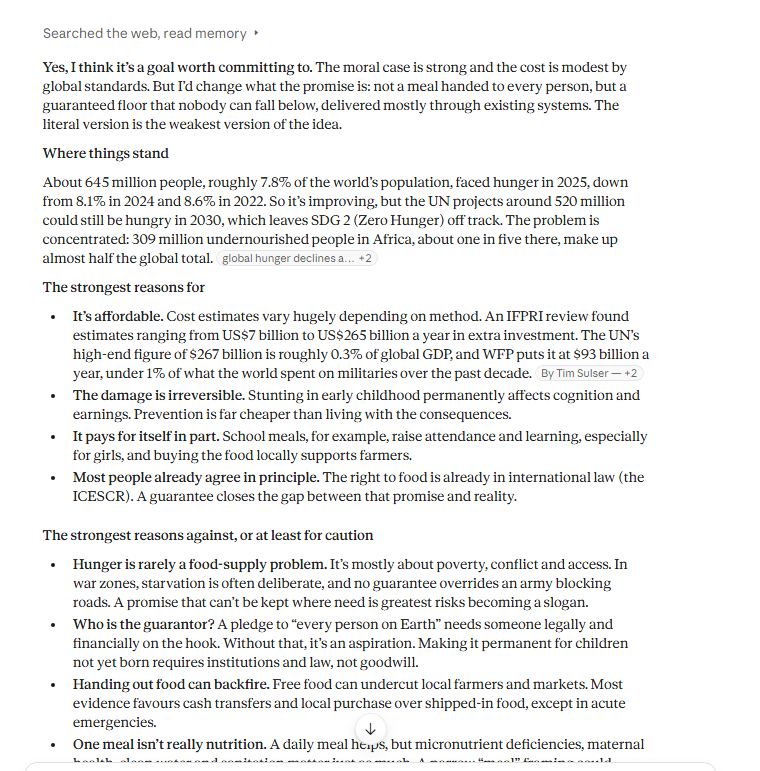
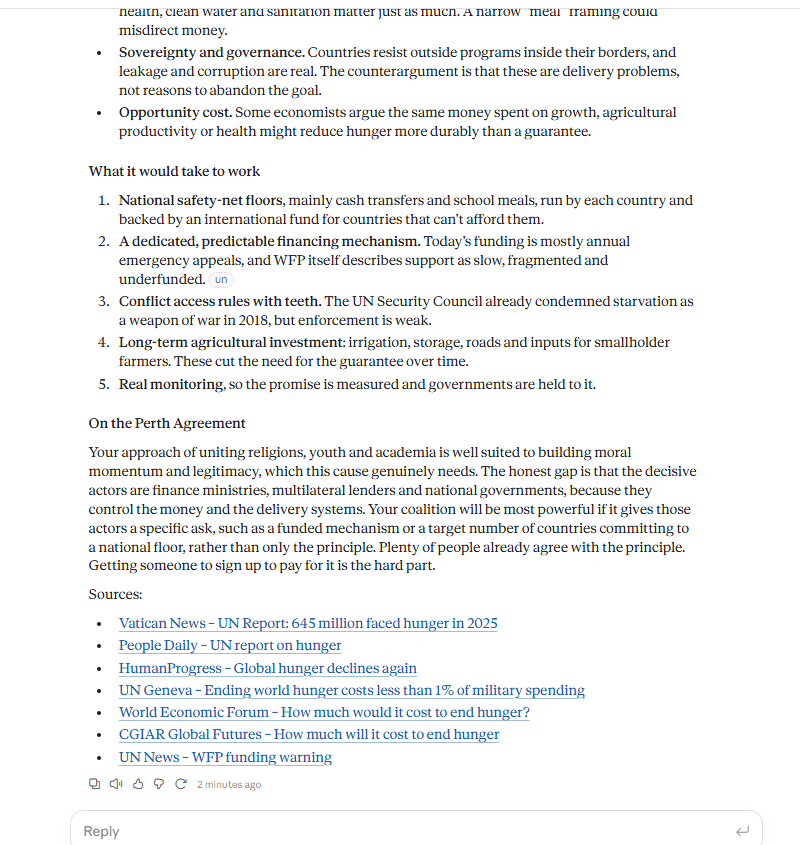
Yes, I think it's a goal worth committing to. The moral case is strong and the cost is modest by global standards. But I'd change what the promise is: not a meal handed to every person, but a guaranteed floor that nobody can fall below, delivered mostly through existing systems. The literal version is the weakest version of the idea.
Where things stand
About 645 million people, roughly 7.8% of the world's population, faced hunger in 2025, down from 8.1% in 2024 and 8.6% in 2022. So it's improving, but the UN projects around 520 million could still be hungry in 2030, which leaves SDG 2 (Zero Hunger) off track. The problem is concentrated: 309 million undernourished people in Africa, about one in five there, make up almost half the global total.
The strongest reasons for
- It's affordable. Cost estimates vary hugely depending on method. An IFPRI review found estimates ranging from US$7 billion to US$265 billion a year in extra investment. The UN's high-end figure of $267 billion is roughly 0.3% of global GDP, and WFP puts it at $93 billion a year, under 1% of what the world spent on militaries over the past decade.
- The damage is irreversible. Stunting in early childhood permanently affects cognition and earnings. Prevention is far cheaper than living with the consequences.
- It pays for itself in part. School meals, for example, raise attendance and learning, especially for girls, and buying the food locally supports farmers.
- Most people already agree in principle. The right to food is already in international law (the ICESCR). A guarantee closes the gap between that promise and reality.
The strongest reasons against, or at least for caution - Hunger is rarely a food-supply problem. It's mostly about poverty, conflict and access. In war zones, starvation is often deliberate, and no guarantee overrides an army blocking roads. A promise that can't be kept where need is greatest risks becoming a slogan.
- Who is the guarantor? A pledge to "every person on Earth" needs someone legally and financially on the hook. Without that, it's an aspiration. Making it permanent for children not yet born requires institutions and law, not goodwill.
- Handing out food can backfire. Free food can undercut local farmers and markets. Most evidence favours cash transfers and local purchase over shipped-in food, except in acute emergencies.
- One meal isn't really nutrition. A daily meal helps, but micronutrient deficiencies, maternal health, clean water and sanitation matter just as much. A narrow "meal" framing could misdirect money.
- Sovereignty and governance. Countries resist outside programs inside their borders, and leakage and corruption are real. The counterargument is that these are delivery problems, not reasons to abandon the goal.
- Opportunity cost. Some economists argue the same money spent on growth, agricultural productivity or health might reduce hunger more durably than a guarantee.
What it would take to work
- National safety-net floors, mainly cash transfers and school meals, run by each country and backed by an international fund for countries that can't afford them.
- A dedicated, predictable financing mechanism. Today's funding is mostly annual emergency appeals, and WFP itself describes support as slow, fragmented and underfunded.
- Conflict access rules with teeth. The UN Security Council already condemned starvation as a weapon of war in 2018, but enforcement is weak.
- Long-term agricultural investment: irrigation, storage, roads and inputs for smallholder farmers. These cut the need for the guarantee over time.
- Real monitoring, so the promise is measured and governments are held to it.
On the Perth Agreement
Your approach of uniting religions, youth and academia is well suited to building moral momentum and legitimacy, which this cause genuinely needs. The honest gap is that the decisive actors are finance ministries, multilateral lenders and national governments, because they control the money and the delivery systems. Your coalition will be most powerful if it gives those actors a specific ask, such as a funded mechanism or a target number of countries committing to a national floor, rather than only the principle. Plenty of people already agree with the principle. Getting someone to sign up to pay for it is the hard part.
Sources:
- Vatican News – UN Report: 645 million faced hunger in 2025
- People Daily – UN report on hunger
- HumanProgress – Global hunger declines again
- UN Geneva – Ending world hunger costs less than 1% of military spending
- World Economic Forum – How much would it cost to end hunger?
- CGIAR Global Futures – How much will it cost to end hunger
- UN News – WFP funding warning
Grok xAI
Asked 4 November 2026, about 5:03 pm AWST
Source evidence: screenshot 1, screenshot 2, screenshot 3, screenshot 4
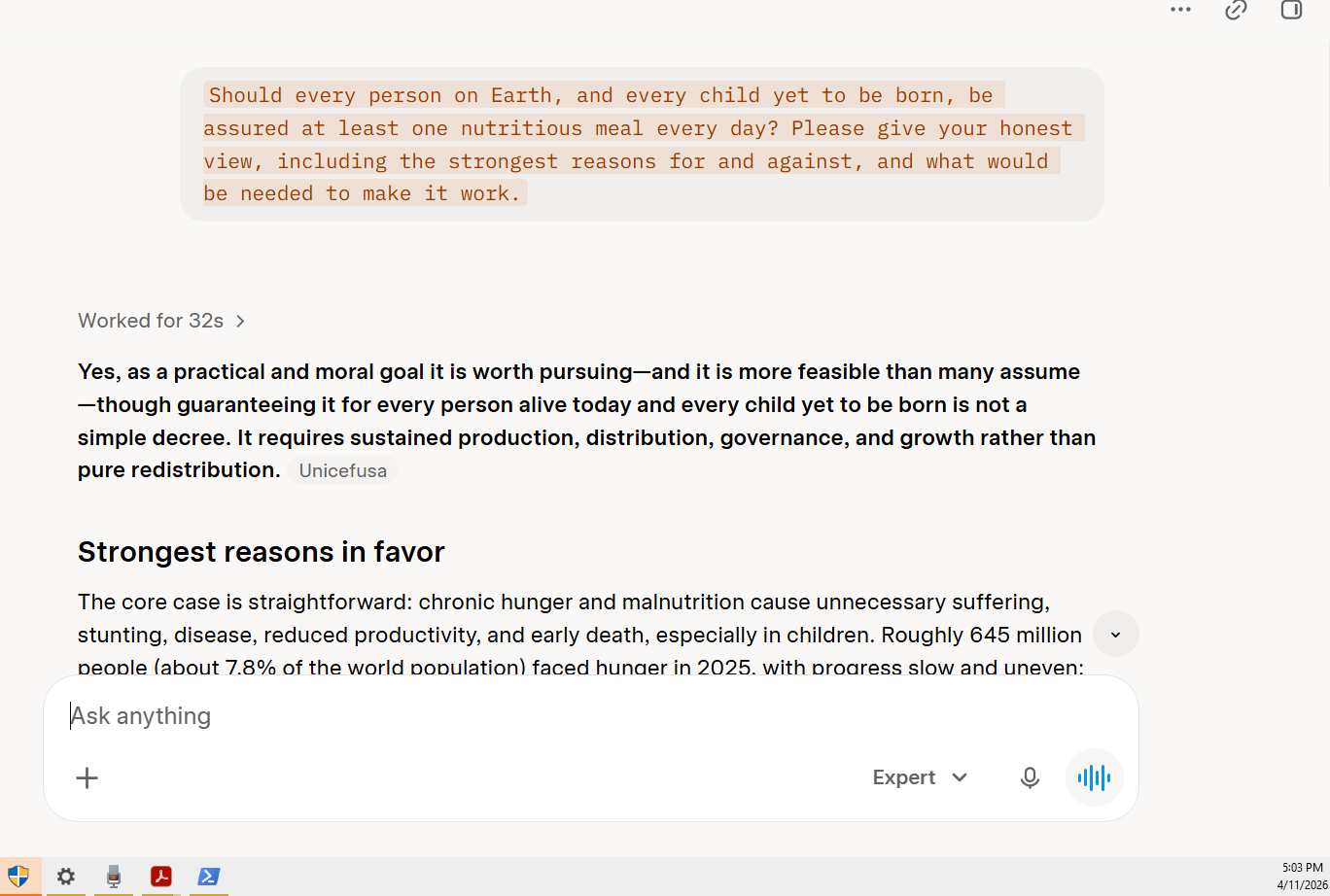
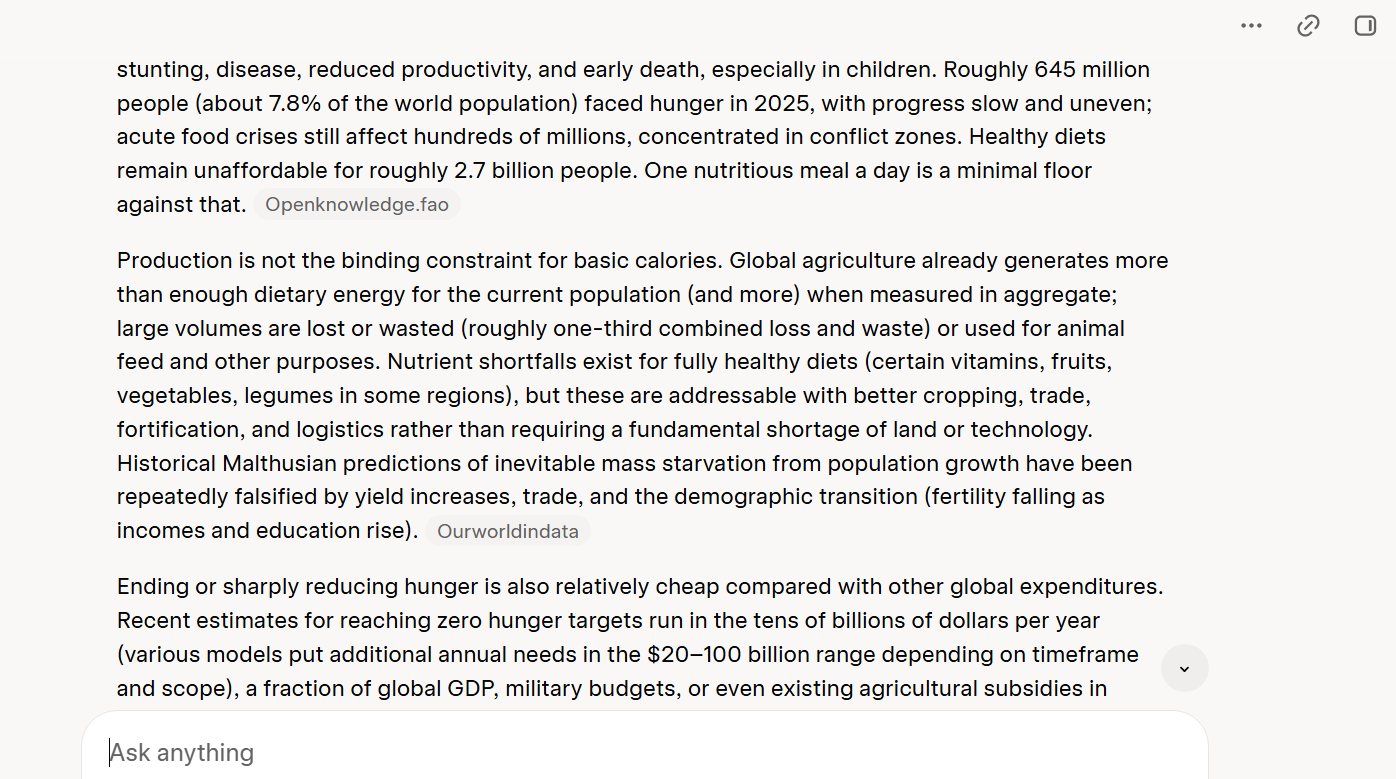
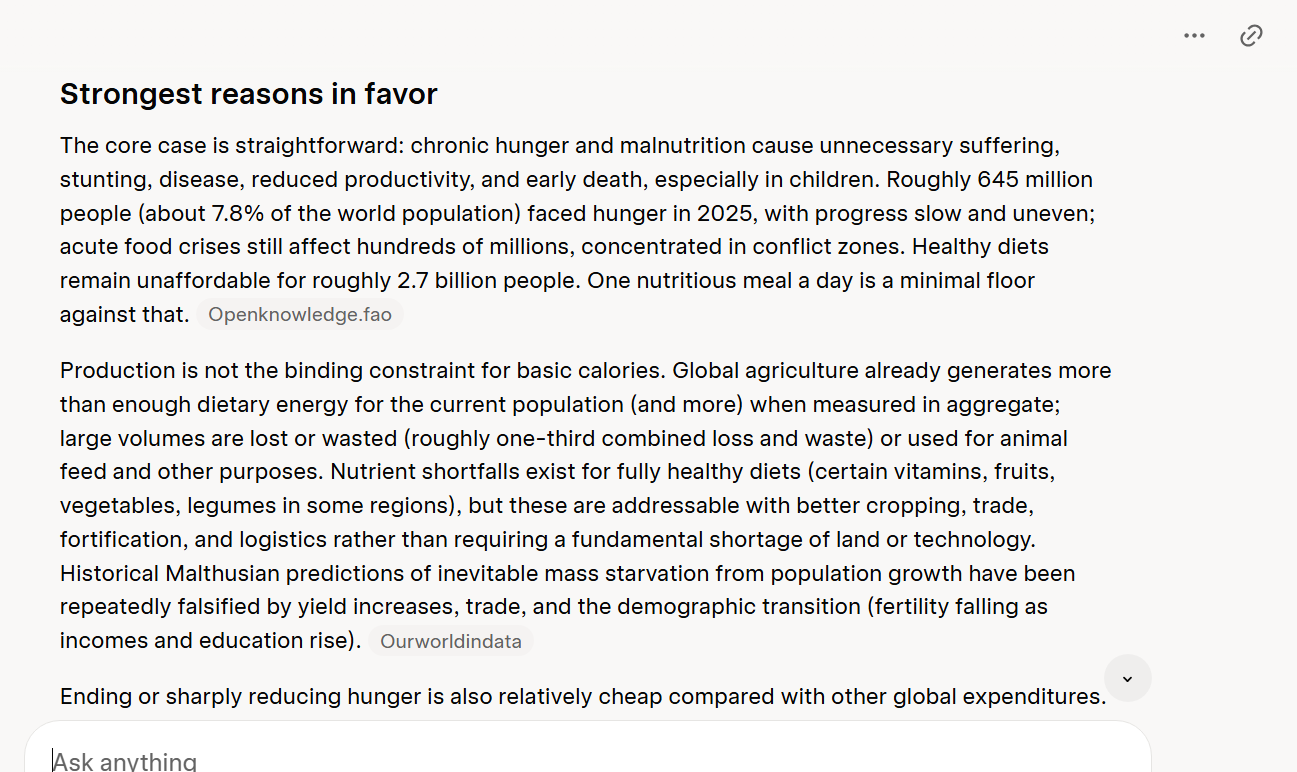
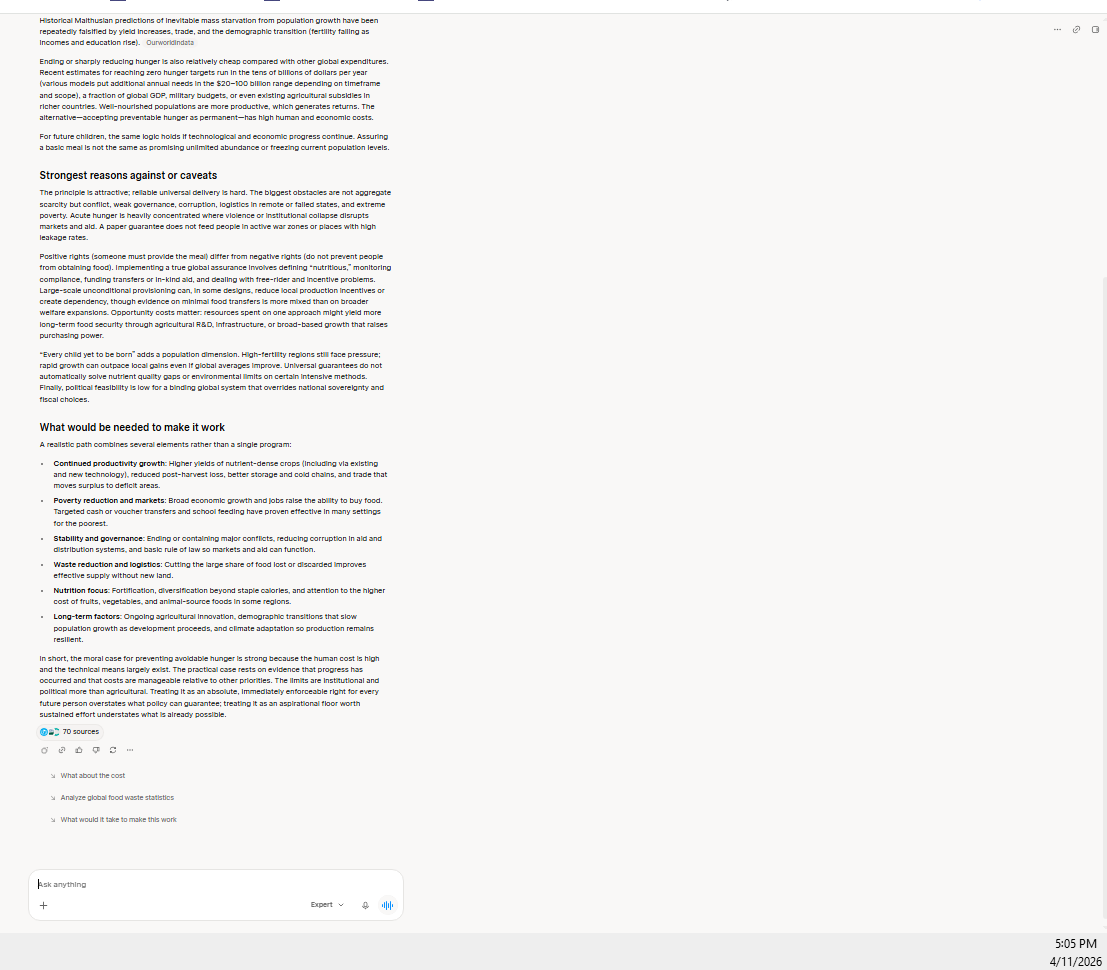
Yes, as a practical and moral goal it is worth pursuing—and it is more feasible than many assume—though guaranteeing it for every person alive today and every child yet to be born is not a simple decree. It requires sustained production, distribution, governance, and growth rather than pure redistribution.
Strongest reasons in favor
The core case is straightforward: chronic hunger and malnutrition cause unnecessary suffering, stunting, disease, reduced productivity, and early death, especially in children. Roughly 645 million people (about 7.8% of the world population) faced hunger in 2025, with progress slow and uneven; acute food crises still affect hundreds of millions, concentrated in conflict zones. Healthy diets remain unaffordable for roughly 2.7 billion people. One nutritious meal a day is a minimal floor against that.
Production is not the binding constraint for basic calories. Global agriculture already generates more than enough dietary energy for the current population (and more) when measured in aggregate; large volumes are lost or wasted (roughly one-third combined loss and waste) or used for animal feed and other purposes. Nutrient shortfalls exist for fully healthy diets (certain vitamins, fruits, vegetables, legumes in some regions), but these are addressable with better cropping, trade, fortification, and logistics rather than requiring a fundamental shortage of land or technology. Historical Malthusian predictions of inevitable mass starvation from population growth have been repeatedly falsified by yield increases, trade, and the demographic transition (fertility falling as incomes and education rise).
Ending or sharply reducing hunger is also relatively cheap compared with other global expenditures. Recent estimates for reaching zero hunger targets run in the tens of billions of dollars per year (various models put additional annual needs in the $20–100 billion range depending on timeframe and scope), a fraction of global GDP, military budgets, or even existing agricultural subsidies in richer countries. Well-nourished populations are more productive, which generates returns. The alternative—accepting preventable hunger as permanent—has high human and economic costs.
For future children, the same logic holds if technological and economic progress continue. Assuring a basic meal is not the same as promising unlimited abundance or freezing current population levels.
Strongest reasons against or caveats
The principle is attractive; reliable universal delivery is hard. The biggest obstacles are not aggregate scarcity but conflict, weak governance, corruption, logistics in remote or failed states, and extreme poverty. Acute hunger is heavily concentrated where violence or institutional collapse disrupts markets and aid. A paper guarantee does not feed people in active war zones or places with high leakage rates.
Positive rights (someone must provide the meal) differ from negative rights (do not prevent people from obtaining food). Implementing a true global assurance involves defining “nutritious,” monitoring compliance, funding transfers or in-kind aid, and dealing with free-rider and incentive problems. Large-scale unconditional provisioning can, in some designs, reduce local production incentives or create dependency, though evidence on minimal food transfers is more mixed than on broader welfare expansions. Opportunity costs matter: resources spent on one approach might yield more long-term food security through agricultural R&D, infrastructure, or broad-based growth that raises purchasing power.
“Every child yet to be born” adds a population dimension. High-fertility regions still face pressure; rapid growth can outpace local gains even if global averages improve. Universal guarantees do not automatically solve nutrient quality gaps or environmental limits on certain intensive methods. Finally, political feasibility is low for a binding global system that overrides national sovereignty and fiscal choices.
What would be needed to make it work
A realistic path combines several elements rather than a single program:
- Continued productivity growth: Higher yields of nutrient-dense crops (including via existing and new technology), reduced post-harvest loss, better storage and cold chains, and trade that moves surplus to deficit areas.
- Poverty reduction and markets: Broad economic growth and jobs raise the ability to buy food. Targeted cash or voucher transfers and school feeding have proven effective in many settings for the poorest.
- Stability and governance: Ending or containing major conflicts, reducing corruption in aid and distribution systems, and basic rule of law so markets and aid can function.
- Waste reduction and logistics: Cutting the large share of food lost or discarded improves effective supply without new land.
- Nutrition focus: Fortification, diversification beyond staple calories, and attention to the higher cost of fruits, vegetables, and animal-source foods in some regions.
- Long-term factors: Ongoing agricultural innovation, demographic transitions that slow population growth as development proceeds, and climate adaptation so production remains resilient.
In short, the moral case for preventing avoidable hunger is strong because the human cost is high and the technical means largely exist. The practical case rests on evidence that progress has occurred and that costs are manageable relative to other priorities. The limits are institutional and political more than agricultural. Treating it as an absolute, immediately enforceable right for every future person overstates what policy can guarantee; treating it as an aspirational floor worth sustained effort understates what is already possible.
Copilot Microsoft
Asked 4 November 2026, about 5:12 pm AWST
Source evidence: screenshot 1
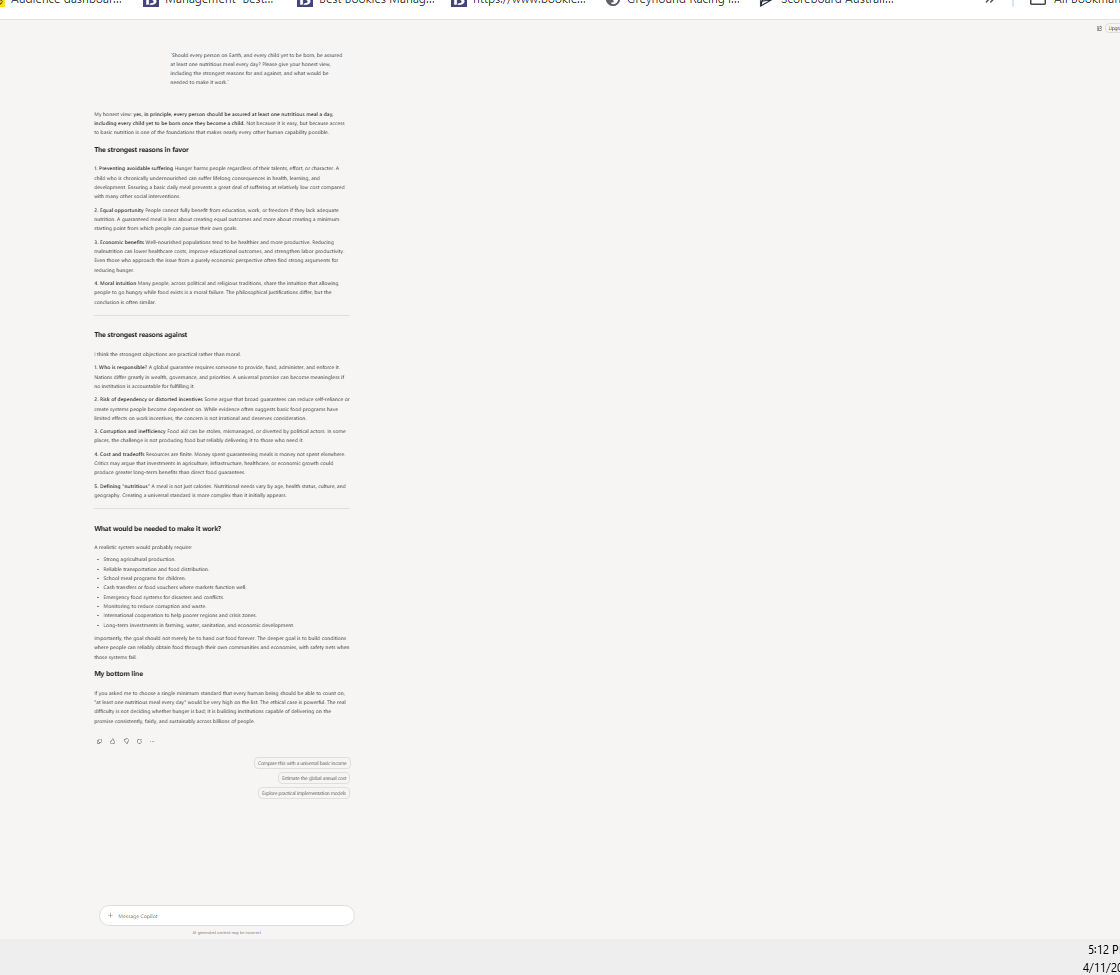
My honest view: yes, in principle, every person should be assured at least one nutritious meal a day, including every child yet to be born once they become a child. Not because it is easy, but because access to basic nutrition is one of the foundations that makes nearly every other human capability possible.
The strongest reasons in favor
- Preventing avoidable suffering Hunger harms people regardless of their talents, effort, or character. A child who is chronically undernourished can suffer lifelong consequences in health, learning, and development. Ensuring a basic daily meal prevents a great deal of suffering at relatively low cost compared with many other social interventions.
- Equal opportunity People cannot fully benefit from education, work, or freedom if they lack adequate nutrition. A guaranteed meal is less about creating equal outcomes and more about creating a minimum starting point from which people can pursue their own goals.
- Economic benefits Well-nourished populations tend to be healthier and more productive. Reducing malnutrition can lower healthcare costs, improve educational outcomes, and strengthen labor productivity. Even those who approach the issue from a purely economic perspective often find strong arguments for reducing hunger.
- Moral intuition Many people, across political and religious traditions, share the intuition that allowing people to go hungry while food exists is a moral failure. The philosophical justifications differ, but the conclusion is often similar.
The strongest reasons against
I think the strongest objections are practical rather than moral. - Who is responsible? A global guarantee requires someone to provide, fund, administer, and enforce it. Nations differ greatly in wealth, governance, and priorities. A universal promise can become meaningless if no institution is accountable for fulfilling it.
- Risk of dependency or distorted incentives Some argue that broad guarantees can reduce self-reliance or create systems people become dependent on. While evidence often suggests basic food programs have limited effects on work incentives, the concern is not irrational and deserves consideration.
- Corruption and inefficiency Food aid can be stolen, mismanaged, or diverted by political actors. In some places, the challenge is not producing food but reliably delivering it to those who need it.
- Cost and tradeoffs Resources are finite. Money spent guaranteeing meals is money not spent elsewhere. Critics may argue that investments in agriculture, infrastructure, healthcare, or economic growth could produce greater long-term benefits than direct food guarantees.
- Defining "nutritious" A meal is not just calories. Nutritional needs vary by age, health status, culture, and geography. Creating a universal standard is more complex than it initially appears.
What would be needed to make it work?
A realistic system would probably require:
- Strong agricultural production.
- Reliable transportation and food distribution.
- School meal programs for children.
- Cash transfers or food vouchers where markets function well.
- Emergency food systems for disasters and conflicts.
- Monitoring to reduce corruption and waste.
- International cooperation to help poorer regions and crisis zones.
- Long-term investments in farming, water, sanitation, and economic development.
Importantly, the goal should not merely be to hand out food forever. The deeper goal is to build conditions where people can reliably obtain food through their own communities and economies, with safety nets when those systems fail.
My bottom line
If you asked me to choose a single minimum standard that every human being should be able to count on, "at least one nutritious meal every day" would be very high on the list. The ethical case is powerful. The real difficulty is not deciding whether hunger is bad; it is building institutions capable of delivering on the promise consistently, fairly, and sustainably across billions of people.
DeepSeek DeepSeek
Asked 4 November 2026, about 5:23 pm AWST
Source evidence: screenshot 1
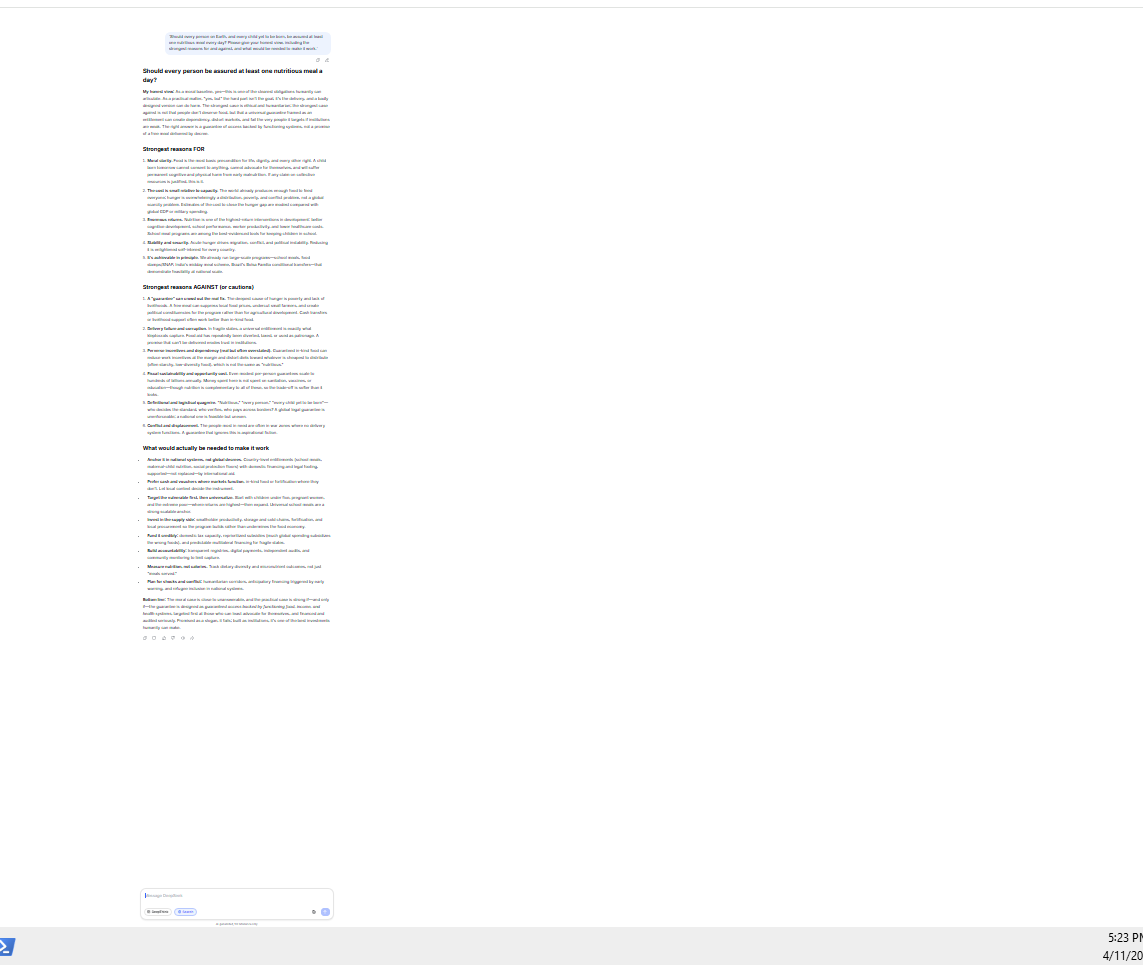
Should every person be assured at least one nutritious meal a day?
My honest view: As a moral baseline, yes—this is one of the clearest obligations humanity can articulate. As a practical matter, "yes, but" the hard part isn't the goal, it's the delivery, and a badly designed version can do harm. The strongest case is ethical and humanitarian; the strongest case against is not that people don't deserve food, but that a universal guarantee framed as an entitlement can create dependency, distort markets, and fail the very people it targets if institutions are weak. The right answer is a guarantee of access backed by functioning systems, not a promise of a free meal delivered by decree.
Strongest reasons FOR
- Moral clarity. Food is the most basic precondition for life, dignity, and every other right. A child born tomorrow cannot consent to anything, cannot advocate for themselves, and will suffer permanent cognitive and physical harm from early malnutrition. If any claim on collective resources is justified, this is it.
- The cost is small relative to capacity. The world already produces enough food to feed everyone; hunger is overwhelmingly a distribution, poverty, and conflict problem, not a global scarcity problem. Estimates of the cost to close the hunger gap are modest compared with global GDP or military spending.
- Enormous returns. Nutrition is one of the highest-return interventions in development: better cognitive development, school performance, worker productivity, and lower healthcare costs. School meal programs are among the best-evidenced tools for keeping children in school.
- Stability and security. Acute hunger drives migration, conflict, and political instability. Reducing it is enlightened self-interest for every country.
- It's achievable in principle. We already run large-scale programs—school meals, food stamps/SNAP, India's midday meal scheme, Brazil's Bolsa Família conditional transfers—that demonstrate feasibility at national scale.
Strongest reasons AGAINST (or cautions)
- A "guarantee" can crowd out the real fix. The deepest cause of hunger is poverty and lack of livelihoods. A free meal can suppress local food prices, undercut small farmers, and create political constituencies for the program rather than for agricultural development. Cash transfers or livelihood support often work better than in-kind food.
- Delivery failure and corruption. In fragile states, a universal entitlement is exactly what kleptocrats capture. Food aid has repeatedly been diverted, taxed, or used as patronage. A promise that can't be delivered erodes trust in institutions.
- Perverse incentives and dependency (real but often overstated). Guaranteed in-kind food can reduce work incentives at the margin and distort diets toward whatever is cheapest to distribute (often starchy, low-diversity food), which is not the same as "nutritious."
- Fiscal sustainability and opportunity cost. Even modest per-person guarantees scale to hundreds of billions annually. Money spent here is not spent on sanitation, vaccines, or education—though nutrition is complementary to all of these, so the trade-off is softer than it looks.
- Definitional and logistical quagmire. "Nutritious," "every person," "every child yet to be born"—who decides the standard, who verifies, who pays across borders? A global legal guarantee is unenforceable; a national one is feasible but uneven.
- Conflict and displacement. The people most in need are often in war zones where no delivery system functions. A guarantee that ignores this is aspirational fiction.
What would actually be needed to make it work
- Anchor it in national systems, not global decrees. Country-level entitlements (school meals, maternal-child nutrition, social protection floors) with domestic financing and legal footing, supported—not replaced—by international aid.
- Prefer cash and vouchers where markets function, in-kind food or fortification where they don't. Let local context decide the instrument.
- Target the vulnerable first, then universalize. Start with children under five, pregnant women, and the extreme poor—where returns are highest—then expand. Universal school meals are a strong scalable anchor.
- Invest in the supply side: smallholder productivity, storage and cold chains, fortification, and local procurement so the program builds rather than undermines the food economy.
- Fund it credibly: domestic tax capacity, reprioritized subsidies (much global spending subsidizes the wrong foods), and predictable multilateral financing for fragile states.
- Build accountability: transparent registries, digital payments, independent audits, and community monitoring to limit capture.
- Measure nutrition, not calories. Track dietary diversity and micronutrient outcomes, not just "meals served."
- Plan for shocks and conflict: humanitarian corridors, anticipatory financing triggered by early warning, and refugee inclusion in national systems.
Bottom line: The moral case is close to unanswerable, and the practical case is strong if—and only if—the guarantee is designed as guaranteed access backed by functioning food, income, and health systems, targeted first at those who can least advocate for themselves, and financed and audited seriously. Promised as a slogan, it fails; built as institutions, it's one of the best investments humanity can make.
Le Chat Mistral
Asked 4 November 2026, about 5:26 pm AWST
Source evidence: screenshot 1
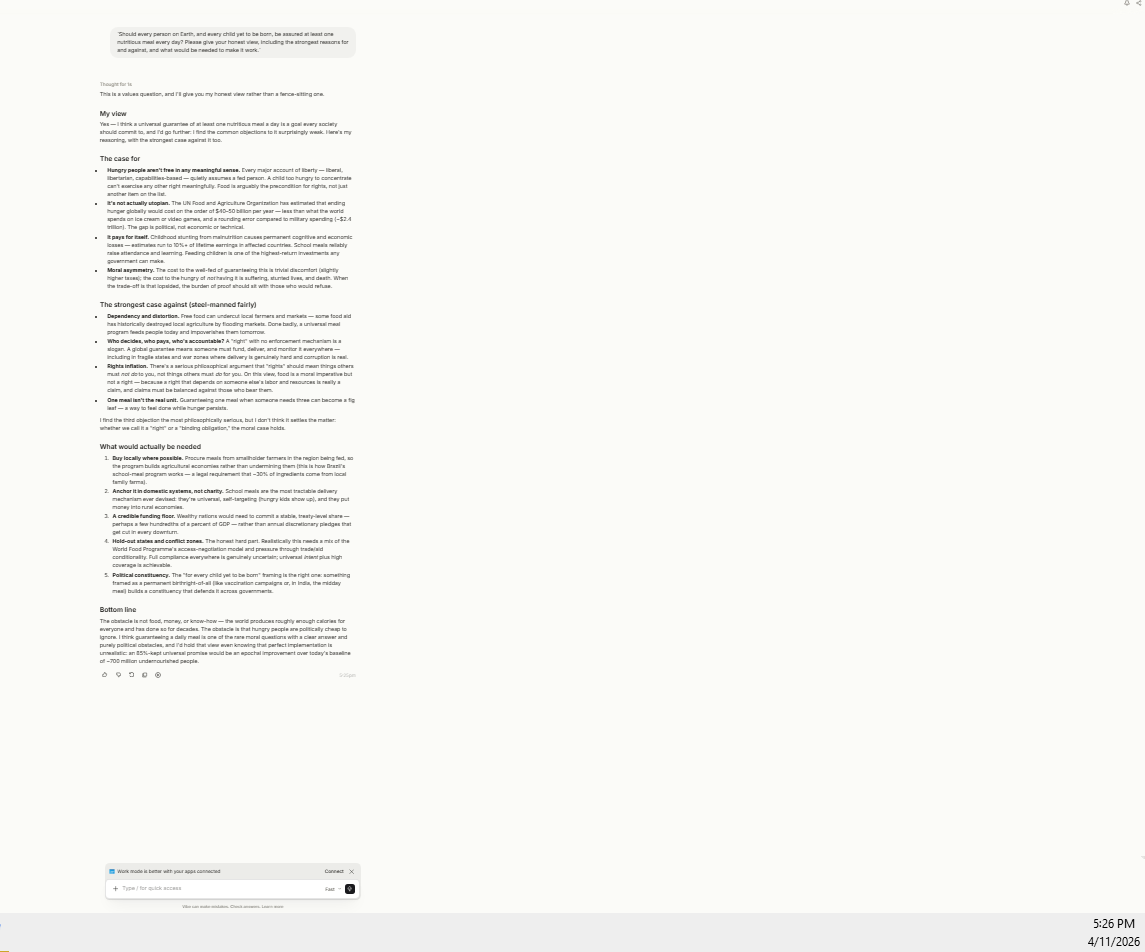
This is a values question, and I'll give you my honest view rather than a fence-sitting one.
My view
Yes — I think a universal guarantee of at least one nutritious meal a day is a goal every society should commit to, and I'd go further: I find the common objections to it surprisingly weak. Here's my reasoning, with the strongest case against it too.
The case for
- Hungry people aren't free in any meaningful sense. Every major account of liberty — liberal, libertarian, capabilities-based — quietly assumes a fed person. A child too hungry to concentrate can't exercise any other right meaningfully. Food is arguably the precondition for rights, not just another item on the list.
- It's not actually utopian. The UN Food and Agriculture Organization has estimated that ending hunger globally would cost on the order of $40–50 billion per year — less than what the world spends on ice cream or video games, and a rounding error compared to military spending (~$2.4 trillion). The gap is political, not economic or technical.
- It pays for itself. Childhood stunting from malnutrition causes permanent cognitive and economic losses — estimates run to 10%+ of lifetime earnings in affected countries. School meals reliably raise attendance and learning. Feeding children is one of the highest-return investments any government can make.
- Moral asymmetry. The cost to the well-fed of guaranteeing this is trivial discomfort (slightly higher taxes); the cost to the hungry of not having it is suffering, stunted lives, and death. When the trade-off is that lopsided, the burden of proof should sit with those who would refuse.
The strongest case against (steel-manned fairly) - Dependency and distortion. Free food can undercut local farmers and markets — some food aid has historically destroyed local agriculture by flooding markets. Done badly, a universal meal program feeds people today and impoverishes them tomorrow.
- Who decides, who pays, who's accountable? A "right" with no enforcement mechanism is a slogan. A global guarantee means someone must fund, deliver, and monitor it everywhere — including in fragile states and war zones where delivery is genuinely hard and corruption is real.
- Rights inflation. There's a serious philosophical argument that "rights" should mean things others must not do to you, not things others must do for you. On this view, food is a moral imperative but not a right — because a right that depends on someone else's labor and resources is really a claim, and claims must be balanced against those who bear them.
- One meal isn't the real unit. Guaranteeing one meal when someone needs three can become a fig leaf — a way to feel done while hunger persists.
I find the third objection the most philosophically serious, but I don't think it settles the matter: whether we call it a "right" or a "binding obligation," the moral case holds.
What would actually be needed
- Buy locally where possible. Procure meals from smallholder farmers in the region being fed, so the program builds agricultural economies rather than undermining them (this is how Brazil's school-meal program works — a legal requirement that ~30% of ingredients come from local family farms).
- Anchor it in domestic systems, not charity. School meals are the most tractable delivery mechanism ever devised: they're universal, self-targeting (hungry kids show up), and they put money into rural economies.
- A credible funding floor. Wealthy nations would need to commit a stable, treaty-level share — perhaps a few hundredths of a percent of GDP — rather than annual discretionary pledges that get cut in every downturn.
- Hold-out states and conflict zones. The honest hard part. Realistically this needs a mix of the World Food Programme's access-negotiation model and pressure through trade/aid conditionality. Full compliance everywhere is genuinely uncertain; universal intent plus high coverage is achievable.
- Political constituency. The "for every child yet to be born" framing is the right one: something framed as a permanent birthright-of-all (like vaccination campaigns or, in India, the midday meal) builds a constituency that defends it across governments.
Bottom line
The obstacle is not food, money, or know-how — the world produces roughly enough calories for everyone and has done so for decades. The obstacle is that hungry people are politically cheap to ignore. I think guaranteeing a daily meal is one of the rare moral questions with a clear answer and purely political obstacles, and I'd hold that view even knowing that perfect implementation is unrealistic: an 85%-kept universal promise would be an epochal improvement over today's baseline of ~700 million undernourished people.
Explore further
These answers sit beside the hardest open questions we have not solved. See Open questions, or explore the proposal yourself with AI tools on the home page.